Monday, 4 July 2011

Ujikaji 2

Fun Egg Experiment

Watch this fun egg experiment video which shows what happens when an egg is placed on top of a bottle after matches have been lit and dropped inside. Enjoy the slow motion replay and try sucking an egg into a bottle yourself! (remembering to get help from an adult and to be careful with matches of course). Is the egg really being sucked inside or is it being pushed? What's causing it to happen?


Sudut Bacaan 2 Kenapa Matahari Terbenam Berwarna Merah?

WHY IS THE SUNSET RED?

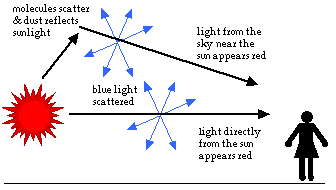
As the sun begins to set, the light must travel farther through the atmosphere before it gets to you. More of the light is reflected and scattered. As less reaches you directly, the sun appears less bright. The color of the sun itself appears to change, first to orange and then to red. This is because even more of the short wavelength blues and greens are now scattered. Only the longer wavelengths are left in the direct beam that reaches your eyes.


Sun red at sunset

The sky around the setting sun may take on many colors. The most spectacular shows occur when the air contains many small particles of dust or water. These particles reflect light in all directions. Then, as some of the light heads towards you, different amounts of the shorter wavelength colors are scattered out. You see the longer wavelengths, and the sky appears red, pink or orange.

Sumber : http://www.sciencemadesimple.com

Sudut Bacaan 1 Kenapa Langit Berwarna Biru?


Why is the sky blue?


Light is a kind of energy that can travel through space. Light from the sun or a light bulb looks white, but it is really a mixture of many colors. The colors in white light are red, orange, yellow, green, blue and violet. You can see these colors when you look at a rainbow in the sky.

Rainbow Picture

The sky is filled with air. Air is a mixture of tiny gas molecules and small bits of solid stuff, like dust.
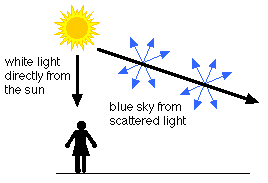
As sunlight goes through the air, it bumps into the molecules and dust. When light hits a gas molecule, it may bounce off in a different direction. Some colors of light, like red and orange, pass straight through the air. But most of the blue light bounces off in all directions. In this way, the blue light gets scattered all around the sky.
When you look up, some of this blue light reaches your eyes from all over the sky. Since you see blue light from everywhere overhead, the sky looks blue.

Sky blue from scattered light

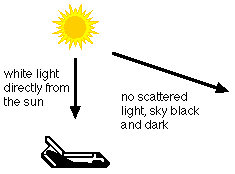
In space, there is no air. Because there is nothing for the light to bounce off, it just goes straight. None of the light gets scattered, and the "sky" looks dark and black.


Black sky in space
Sumber :http://www.sciencemadesimple.com

Projek Sains 3

Indoor Rain

You can create a little indoor rain in a jar with this science experiment for kids. Create indoor rain with warm, moist air that rises up and hits colder air above it. 
What You'll Need:
  • Jar with lid
  • Hot water
  • Ice cubes 
Step 1: Put a small amount of hot tap water in the jar.
Step 2: Place the lid upside down on top of the jar.
Step 3: Put several ice cubes inside the lid.
You will be able to observe moisture forming on the lid top inside the jar, and soon you'll see the moisture drip down like rain. Warm air can hold more moisture than cold air. When warm air in the sky hits cold air higher up, it condenses, turns into water vapor, and rains!

Projek Sains 2

Ocean in a Bottle

Create an ocean in a bottle by trying a test on oil and water. When you're finished, you can turn this science experiment for kids into a decorative display.

ocean in a bottle experiment
©2007, Publications International, Ltd.
Make an ocean in a bottle with oil and water.
What You'll Need:
  • Funnel
  • Clear soda bottle
  • Water
  • Cooking oil
  • Blue food coloring
  • Glitter 
Step 1: Using a funnel, pour 1/2 cup of water and 1/2 cup of oil into a soda bottle.
Step 2: Put the lid on tightly, and shake the bottle vigorously to mix the substances.
Step 3: After shaking, put the bottle down and let it sit for a few minutes. What happens to the oil and water after you mix them?
Step 4: To turn your experiment into an ocean display, remove the top and add enough water to fill the bottle 2/3 full.
Step 5: Add a few drops of food coloring and some glitter, and shake the bottle gently to mix in the color.
Step 6: Fill the rest of the bottle almost to the top with oil.
Step 7: Put the top back on tightly, and gently tilt the bottle back and forth to create an ocean wave effect.
Go to the next page to find out how hot air and an expanding balloon go together.


Sumber: http://tlc.howstuffworks.com

PROJECT 1 - Split light into a spectrum


SAFETY NOTE: Please read all instructions completely before starting. Observe all safety precautions.


PROJECT 1 - Split light into a spectrum

What you need:

a small mirror, a piece of white paper or cardboard, water
a large shallow bowl, pan, or plastic shoebox
a window with direct sunlight coming in, or a sunny day outdoor
What to do:
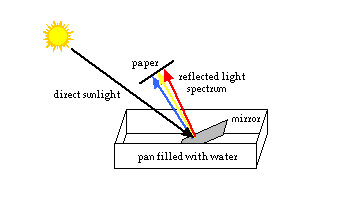
  1. Fill the bowl or pan about 2/3 full of water. Place it on a table or the floor, directly in the sunlight. (Note: the direct sunlight is important for this experiment to work right.)
  2. Hold the mirror under water, facing towards the sun. Hold the paper above and in front of the mirror. Adjust the positions of the paper and mirror until the reflected light shines on the paper. Observe the colored spectrum.


experiment

What happened: The water and mirror acted like a prism, splitting the light into the colors of the spectrum. (When light passes from one medium to another, for example from air to water, its speed and direction change. [This is called refraction, and will be discussed in a future issue.] The different colors of light are affected differently. Violet light slows the most, and bends the most. Red light slows and bends the least. The different colors of light are spread out and separated, and we can see the spectrum.)


PROJECT 2 - Sky in a jar

What you need:

a clear, straight-sided drinking glass, or clear plastic or glass jar
water, milk, measuring spoons, flashlight
a darkened room
What to do:
  1. Fill the glass or jar about 2/3 full of water (about 8 - 12 oz. or 250 - 400 ml)
  2. Add 1/2 to 1 teaspoon (2 - 5 ml) milk and stir.
  3. Take the glass and flashlight into a darkened room.
  4. Hold the flashlight above the surface of the water and observe the water in the glass from the side. It should have a slight bluish tint. Now, hold the flashlight to the side of the glass and look through the water directly at the light. The water should have a slightly reddish tint. Put the flashlight under the glass and look down into the water from the top. It should have a deeper reddish tint.
What happened: The small particles of milk suspended in the water scattered the light from the flashlight, like the dust particles and molecules in the air scatter sunlight. When the light shines in the top of the glass, the water looks blue because you see blue light scattered to the side. When you look through the water directly at the light, it appears red because some of the blue was removed by scattering.


PROJECT 3 -Mixing colors

You need:

a pencil, scissors, white cardboard or heavy white paper
crayons or markers, a ruler
a small bowl or a large cup (3 - 4 inch, or 7 - 10 cm diameter rim)
a paper cup
What to do:
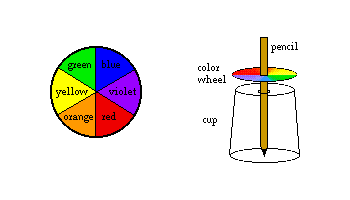
  1. Use the bowl to trace a circle onto a piece of white cardboard and cut it out. With the ruler, divide it into six approximately equal sections.
  2. Color the six sections with the colors of the spectrum as shown. Try to color as smoothly and evenly as possible.
  3. Poke a hole through the middle of the circle and push the pencil part of the way through.
  4. Poke a hole in the bottom of the paper cup, a little bit larger than the diameter of the pencil. Turn the cup upside down on a piece of paper, and put the pencil through so the point rests on the paper on a table. Adjust the color wheel's position on the pencil so that it is about 1/2 inch (1 - 2 cm) above the cup.
  5. Spin the pencil quickly and observe the color wheel. Adjust as necessary so that the pencil and wheel spin easily.


experiment

What happened: The colors on the wheel are the main colors in white light. When the wheel spins fast enough, the colors all appear to blend together, and the wheel looks white. Try experimenting with different color combinations.

Projek Sains 1

Kawan-kawan, baru-baru ini saya telah terjumpa satu projek eksperimen yang menarik. Mari kita ikuti bersama-sama

Istilah Sains


Daripada Wikipedia, ensiklopedia bebas.
'''Sains merupakan sebuah proses pengumpulan ilmu atau maklumat dan penyusunannya. Perkataan sains datang daripada bahasa Latin, scinetia, yang bermakna mendapatkan ilmu atau maklumat. Dan seperti proses mendapatkan maklumat yang lain, sains bermula dengan pengalaman, dan kemudiannya mendapatkan fakta dan peraturan daripadaya.
Cara sains mengkaji sesuatu perkara adalah dengan melihatnya dengan teliti, mengukurnya, membuat uji kaji, dan dengan cuba menerangkan mengapa sesuatu perkara terjadi. Mereka yang melakukan perkara ini dipanggil ahli sains.
Setiap pakar sains perlu berhati-hati apabila memberi penerangan mengenai sesuatu yang mereka kaji. Mereka bertanding untuk memberikan penjelasan yang lebih baik. Boleh jadi sesuatu penjelasan itu menarik, tetapi jika ia tidak sama dengan apa yang dikatakan oleh pakar sains lain, kajian seterusnya perlu dilakukan lagi untuk mendapatkan penjelasan yang lebih baik.
Pakar sains juga memeriksa idea pakar sains lain. Ini kerana pakar sains juga merupakan manusia, yang tidak boleh lari dari melakukan kesilapan. Jadi pakar sains perlu mempastikan bahawa idea yang digunakannya adalah betul. Peer review dan mengulangi eksperimen beberapaka kali merupakan satu-satunya cara untuk mempastikan bahawa maklumat yang diperolehi adalah benar dan tepat.
Inilah yang dipanggil kaedah saintifik. Kebanyakan orang menerima kaedah ini sebagai cara yang paling boleh dipercayai untuk mendapatkan maklumat mengenai alam, dunia, badan manusia atau binatang dan lain-lain. Walau bagaimanapun, perlu diingati bahawa sains merupakan suatu proses yang berterusan, apa yang benar hari ini mungkin kurang tepat dalam masa 100 tahun lagi.

Ujikaji

Uji kajiOneRiotYahooAmazonTwitterdel.icio.us

Daripada Wikipedia, ensiklopedia bebas.
Kanak-kanak kecil juga melakukan ujikaji asas untuk beljar mengenai dunia
Uji kaji (juga ditulis ujikaji) atau eksperimen ialah satu kaedah pengujian - dengan matlamat menjelaskan - sifat realiti. Ujikaji berbeza-beza daripada yang bersifat peribadi dan tidak formal (contohnya merasai pelbagai coklat untuk mencari yang digemari), kepada yang dikawal rapi (misalnya ujian yang memerlukan radas kompleks dan diawasi ramai ahli sains yang mengharap menemui maklumat mengenai zarah subatomik). Lebih formal, uji kaji ialah satu prosedur teratur yang dilakukan dengan matlamat menentusahkan, menentupalsukan, atau memastikan ketepatan suatu hipotesis. Uji kaji banyak berbeza dari segi matlamat dan skala, namun hampir sentiasa bergantung kepada prosedur boleh ulang dan analisis logik keputusannya. Seorang kanak-kanak mungkin menjalankan uji kaji mudah untuk memahami sifat graviti, manakala sekumpulan ahli sains mungkin mengambil masa bertahun-tahun penyiasatan bersistematik untuk meningkatkan pemahaman suatu fenomena.
Uji kaji merupakan langkah dalam kaedah saintifik yang membantu manusia memilih antara dua atau penjelasan – atau hipotesis.